
|
|
|
FILMOGRAFIA
a cura di Dario Chioli
[16/9/2005, 30/4/2007] Ho trovato in Internet indicazioni dei seguenti film su Khayyâm.
Oltre a quanto qui riportato, si confronti in particolare:
Darius Kadivar, Khayyam Mania!!!: Hollywood's depiction of the great Persian Poet's life (http://www.payvand.com/news/03/mar/1039.html).
È una pagina che riporta molti dati sulle rappresentazioni cinematografiche hollywoodiane nonché su altre produzioni artistiche ispirate a Khayyâm.
Filmografia
| Ferdinand Pinney Earle, A Lover's Oath (altro titolo: The Rubaiyat of Omar Khayyam)
«Edited by Milton Sills and starring Ramon Novarro as Ben Ali, with co-stars Kathleen Key as Sherin, Edwin Stevens as Hassen Ben Sabbath, and Frederick Warde as Omar Khayyam. Artistic backgrounds and trick photography were the draws in this romantic drama, based on The Rubaiyat of Omar Khayyam. As Ben Ali, Ramon Novarro practically disappears in the midst of all the camera work and set design, as does his co-star Kathleen Key. The film's titles are, more often than not, direct quotes of the Rubaiyat's verses. As a result, the plot sticks pretty much to the original Edward Fitzgerald translation -- Ben Ali, the son of Omar (Frederick Warde), is engaged to Sherin (Key), but lusty old sheik Hassan Ben Sabbath (Edwin Stevens) wants Sherin for himself. Although Ben Ali gets the girl, Edwin Stevens walks off with the acting honors, and occasionally another actor's presence emerges memorably in the midst of all the fancy backgrounds and harems, most notably funny-faced character actor Snitz Edwards as Omar's servant. |
| James Young, Omar the Tent Maker
«Produced by Richard Walton Tully, was one of the first attempts to adapt Khayyam's life story to the silver screen. It was adapted from the stage play by Tully with mixed results. It shows Omar (Guy Bates Post, who also played the role on stage) as a student in love with Shireen (Virginia Brown Faire), the daughter of his teacher. The couple marry in secret, but the Shah (Noah Beery) has heard of Shireen's beauty and carries her off to his native land. When she turns down his advances, she is imprisoned. Shireen gives birth while she is locked up and the Shah orders that both she and the baby girl be thrown off a cliff. They are saved, and the child is handed over to Omar, but Shireen is sold into slavery. It takes seventeen years for Omar and Shireen to be reunited. During that time, their daughter grows up (to be played by Patsy Ruth Miller), and falls in love with a Christian slave. Do not expect to learn much about Omar Khayyam nor his poems in this Art Deco style silent film, but it has the charm of its time». |
| Brian Foy, Omar Khayyam USA, 1924. Muto. «Not much can be said either of Bryan Foy's "Omar Khayyam" based on his screenplay starring Phil Dunham which basically follows the same plot as the one mentioned above». |
Ted Tezlaff, Son of Sinbad
Sommario: «Dale Robertson stars as the Son of Sinbad in this tongue-in-cheek Arabian Nights romp. Hoping to rescue Bagdad from the forces of the dreaded Tamerlaine, Sinbad Jr. enlists the aid of the Khalif (Leon Askin) by promising to deliver the secret of "Greek Fire". To expedite this, he enlists the aid of the lovely Kristina (Mari Blanchard), who has memorized said secret. When the bad guys threaten the safety of hero and heroine, slave girl Ameer (Sally Forrest), who heads the all-female descendants of the original Forty Thieves, come galloping to the rescue. Personally produced by Howard Hughes, Son of Sinbad seems to be a clearing house for all of Hughes' voyeuristic fetishes; at one point, stripteaser Lili St. Cyr performs an exotic (and erotic) dance wearing the equivalent of a postage stamp, earning a Condemned rating from the Catholic Legion of Decency. The overabundance of feminie pulchritude gets a little wearing after a while, and it is up to Vincent Price to steal the show as Omar the Tentmaker, improvising passages of his unpublished "Rubaiyat" (with a few anachronistic Shakespearean quotes thrown in) as he tries to keep apace with the hero. Also on hand is an uncredited (and fully clothed) Kim Novak as a handmaiden. More silly than sexy when seen today, Son of Sinbad is acceptable nonthink entertainment. ~ Hal Erickson, All Movie Guide» (http://movies2.nytimes.com/gst/movies/movie.html?v_id=45624 [10/6/2011: link non più attivo]). «Deux hommes vont être exécuté, Sindbad et Omar, ils ont enfreint la oi et sont entrés dans le harem du Calife de Bagdad. Au même moment la ville risque d'être à feu et à sang, menacée par Murad délégué par Tamerlan. SIndbad et Omar monnayent leur libération contre la formule de "feu gregeois". Ils tiennent cette formule de Simon le père de Christina...» (http://www.yo-video.com/film-12257-fils+de+sindbad+(le).html). Fonti: http://movies2.nytimes.com/gst/movies/movie.html?v_id=45624 [10/6/2011: link non più attivo] e http://www.yo-video.com/film-12257-fils+de+sindbad+(le).html. |
William Dieterle, The Life, Loves and Adventures of Omar Khayyam
Plot Summary by Anonymous: «Omar Khayyam was one of the greatest Persian poets. He was also a brilliant mathematician. Though his quatrains were written in the 11th century, they are still popular the world over. The details of his life are unknown, so this movie invents a biography for him and includes in it his real achievements - the invention of a new calendar and the penning of those epigrammatic poems. This film has him romancing a sultan's bride and foiling the assassin sect's plot to kill the sultan's son» . Dal Morandini 2002: «Consulente astrofisico, scienziato e poeta persiano, Omar Khayyam riformò, con altri astronomi, il calendario nel 1073. Nonostante qualche tocco fiabesco che lo migliora, è mediocre: scenografie modeste, regia di mestiere, attori discreti». Fonti: http://us.imdb.com/title/tt0050799/plotsummary, Morandini 2002 e http://www.soundtrackcollector.com/images/cd/large/Omar_Khayyam_DL8449.jpg. Per approfondimenti e ulteriori immagini cfr. la pagina di Darius Kadivar: http://www.payvand.com/news/03/mar/1039.html |
Layvan Mashayekh, The Keeper: The Legend of Omar Khayyam
«Join director Kayvan Mashayekh, moderator David O. Russell (director of "I Love Huckabees" and "Three Kings"), writer/producer of "Frailty: Tom Huckabee, and international vocal star Andy Madadian for an exclusive preview of "The Keeper," followed by a filmmakers' discussion and reception. This moving feature raises essential questions about roots, identity, storytelling and the meaning of family ties. Kamran is a twelve-year-old boy in the present day who discovers that his ancestor is the 11th-century mathematician, astronomer and poet of Persia, Omar Khayyam. The story has been passed down in his family from one generation to another, and now it is his responsibility to keep the story alive for future generations. His dying brother, Nader, begins telling him the story as we flash back from the modern day to the epic past where the relationship between Omar Khayyam, Hassan Sabbah (the original creator of the sect of Assassins) and their mutual love for a beautiful woman separate them from their eternal bond of friendship. Throughout the telling of the story from Nader to Kamran, we periodically return to the present day to reveal the frailty of life and how stories such as ours easily fade with the passing of each generation. When Nader dies, Kamran cannot contain his curiosity and sets off on a journey to find a book known as "The Great Omar," which was bound nearly 100 years ago and was a lost treasure on the Titanic. He comes across the Heiress (beautifully portrayed by Academy Award winner Vanessa Redgrave) of a mansion in England whose grandfather was the famous bookbinder who created "The Great Omar." It is here, that Kamran learns about the importance of how the poetry of one man 1000 years ago has touched the lives of millions who still echo his verses from one generation to another. Kamran continues his journey to reach his grandfather to learn the end of the story. It is finally revealed to him that it wasn't Omar's poetry that made him important, it was the poetry of his life. Hence, be proud of your heritage because it is the stories in our past that make our future more meaningful. Omar Khayyam lived an outer life of great productivity and renown, in the service of an absolute monarch and under the watchful eye of a strict religious authority. He published nothing but scholarly articles on astronomy and mathematics during his lifetime. His private stash of poems is a map of his inner world, where he roamed without restriction or fear, free to shout suppositions that would have meant death if whispered in public. The message of his Rubaiyat is profoundly simple, devoid of facts but full of meaning, effortlessly erotic and joyously literate. It is philosophical but promotes no particular system. Yet, some have seen it as a mandate for agnostic hedonism and as an esoteric path to Allah. It is antiquarian, slightly futuristic and wholly present, appealing equally to seekers of all ages and both genders. Like an ancient underground stream, connecting the world's religions, races and cultures, it flows just as smoothly in Chinese, French and Hungarian as it does in the original Farsi. It can be used to seduce a lover, soothe the afflicted or bury your father. An idiot can understand it, but a genius may not. Only by the grace of God did Omar's Rubaiyat survive, to show us just how bright some candles burned during the so-called dark ages». Fonte: http://www.levantinecenter.org/Newsletters/newsletter042905.html [10/6/2011: link non più attivo]. |
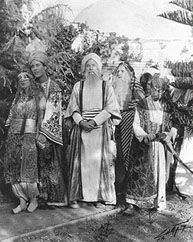 USA, 1922; uscito nel 1925. Muto.
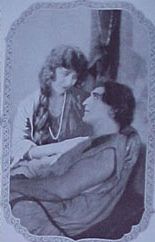 USA, 1922. Muto.
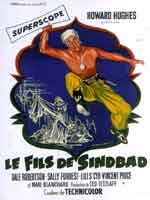 USA, 1953 (altri titoli: Nights in a Harem – in italiano Il figlio di Sinbad). Soggetto: Jack Pollexfen, Aubrey Wisberg. Con Mari Blanchard, Kim Novak, Vincent Price [nel ruolo di Omar Khayyâm], Dale Robertson, Sally Forrest. 91'.
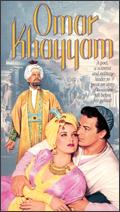 USA, 1957 (altri titoli: Omar Khayyam – The Loves of Omar Khayyam – in italiano Le avventure e gli amori di Omar Khayyam). Soggetto: Barré Lyndon. Con Raymond Massey, Debra Paget, Michael Rennie, John Derek, Cornel Wilde. Partecipazione della cantante Yma Sumac. 101'.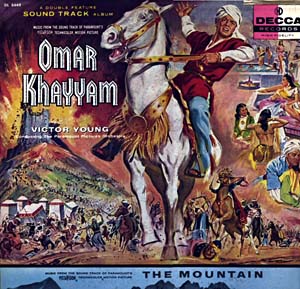
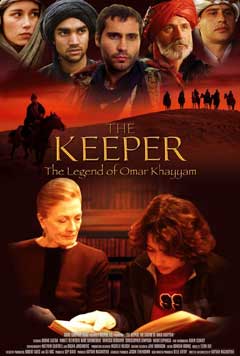 USA, 2005 (altri titoli: Omar Khayyam – The Keeper). Soggetto: Belle Avery, Kayvan Mashayekh. Con Vanessa Redgrave, Moritz Bleibtreu, Rade Serbedzija, Bruno Lastra, Christopher Simpson. 95'.